
Democracy Needs a Barstool
On pubs, proximity, and politics

In a recent piece, I made the case, perhaps a little too earnestly, that gathering matters. That something ineffable happens when we choose to be in the same room, breathing the same air, tolerating the same bullshit. Gathering, I argued, fosters empathy and helps sustain democracy.
A couple of weeks later, I read a piece by Nathan Domon in The European Correspondent, which reports on research into France’s bar-tabacs, those generally unglamorous, entirely essential “third spaces” where you can score a pack of smokes and a lotto ticket, or pass the day with a perfectly passable merlot. According to new research, when bar-tabacs disappear, support for the far right increases. Not dramatically. But consistently enough to matter.
You close a bar-tabac and a few years later, support for the far-right National Rally ticks up a few percentage points. You open one, it ticks down. Same people. Same towns. Same grievances. Different levels of human contact.
Democracy might depend less on grand speeches and more on who you bump into while waiting to pay for a scratch-off. It suggests that what we have been calling “polarization” might, in part, be a proximity issue.
Now, before I wax poetic about the sacredness of the neighborhood pub, a few caveats. As Domon wisely points out, pubs can be exclusionary. They can be male-dominated, culturally narrow, and unwelcoming to outsiders. They can reek of regret and disinfectant. Like other spaces, they can platform bullies and drown voices of decency. There are legit reasons why many people do not feel comfortable in pubs and bar tabacs.
For these reasons and for economic reasons, across Europe, these gathering places are disappearing at a steady clip. In England and Wales, roughly one pub closed every day last year. Since 2020, more than 2,000 pubs have shut their doors. In the Netherlands, one in five cafés has closed since the pandemic.
Germany’s Kneipen, our beloved neighborhood pubs, have been thinning out for years, casualties of rising costs, changing habits, and a population that increasingly prefers its social life curated, filtered, and on the couch.
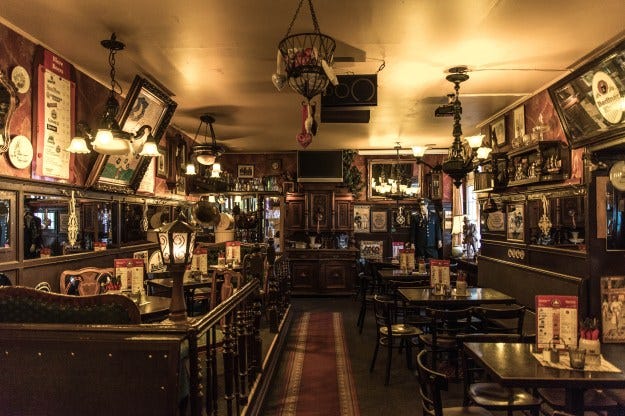
In Brandenburg, where about 40% of voters now support the far-right AfD, more than 70% of Kneipen have shut down in some districts over the past decade. People who are cut off from others tend to be more receptive to right-wing politics.
This is not just a story about booze consumption. The point is not the beer. It’s the friction. It’s the accidental proximity. It’s the minor inconvenience of other people. It’s the low-stakes encounters with folks who don’t vote like you, think like you, or share your algorithm. It’s the quiet, unremarkable act of sharing space with people you did not choose. Not loving them, per se. Not always agreeing with them. Just existing alongside them long enough for them to become slightly less abstract.
When those spaces vanish, we do not stop socializing. We narrow and shrink and sanitize our social lives. We move to group chats and algorithmically-optimized feeds. We spend more time with people who are like us, and less time with people who are not. The experience is smoother. The vibe is easier. The democracy, apparently, is worse.
Drawing on the research of Hugo Subtil of the University of Zurich, Domon makes this point without romanticizing it. These “third spaces” are not inherently virtuous. They do not magically produce empathy. But they create the conditions in which empathy might emerge.
Domon quotes Subtil as saying:
“What matters here is not what people are doing, but the fact that they’re doing it together…It’s the shared, social aspect that makes the difference.”
That’s where shit gets uncomfortable.
Because if empathy requires exposure, and exposure requires shared space, then the slow death of these spaces is not just a cultural shift. It is a civic one.
I’ll cop to my bias: I dig the pub.
I dig the noise, the awkwardness, the perfectly unremarkable bier vom fass. I dig the way conversations start sideways and end nowhere. I dig the fact that you cannot control who is there or what will happen. I dig how unscripted it all is. I dig that it resists optimization.
Not everything is for everyone. Pubs are not for everyone. Bar-tabacs are not for everyone. Kneipen are definitely not for everyone.
But some things, these slightly worn-down, imperfect, occasionally uncomfortable third spaces, are more important than meets the eye.
Again, gathering matters! And it matters more than we think. Annoyingly so. Inconveniently so. Democratically so.
Yours,
DL
P.S. You should subscribe to The European Correspondent. Smart, grounded, pan-European journalism that doesn’t scream at you. International. Intercultural. They email you news you can use every morning. For free! I’m a cheap bastard and a proud paid subscriber. Check ‘em out!
P.S.S. I planned to write a trilogy on empathic engagement (parts 1, 2, and 3). This was the accidental part four, special thanks to Mr. Domon.
Hey you! I’m trying to sustain the quality and frequency of The Junction. It’s a labor of love, but it is labor. It helps me when you subscribe, free or paid. At the very least, enjoy a free subscription.
If you don’t want to become a paid subscriber, but support me and want to show it, PayPal me a one-time donation. If you don’t like PayPal, you can buy me a coffee.
If money is tight, you can still help. How? Share The Junction with someone who might appreciate it.
Oh, and you’re always invited to check out my other projects over here.
This reminds me of the research on how talking to strangers makes us happier. If we live in our own world it gets claustrophobic. Algorithms predict and find patterns, but part of what we need is unpredictability and the unknown. Booze makes it even more fun.
So many great lines (and great thoughts) in this piece! I've been sending different quotes to folks I know.