
No Schlitz Sherlock
Germans and Fires and Beers, Oh My!

I fear it is an understatement to suggest that my past few posts have been a bit, umm, heavy. What can I say? Heavy times y’all. As an antidote, I was trying to conjure some lighter fare to share this week. I sought a tonic to complement my gin; or at least a splash of vermouth to take the edge off my bourbon. Then this cold, bubbly drink spilled in my lap, courtesy of American Treasure, John Dickerson.
Hot off the presses, it’s a story about German immigrants, Chicago, and beer. As a beer-guzzling Chicagoan who immigrated to Germany, how could I resist?
Fleeing the revolutionary tumult of 1840s Europe, hordes of German immigrants, some of them brewers, none of them Brewers

…arrived in Wisconsin with their recipes, techniques, and dogmatic views about what constitutes proper lager. Beer quickly became Milwaukee’s defining industry.
One brewer, Georg August Krug (b. 1815), fled political persecution for being an alleged ringleader (Rädelsführerei) of a dangerous posse of pro-democracy liberal reformers in Bavaria. In 1849, he opened a saloon and brewery in Milwaukee.
Krug hired a bookkeeper, also a German immigrant, named Joseph Schlitz. Despite being a political visionary of sorts, Krug’s vision failed to spot the hatch door in his attic floor, which he fell through, leading to his death. He certainly could not have envisioned that two years later, his dearly beloved wife, Anna Maria Krug, would marry Schlitz, who at age 27, was twelve years her junior.
Scandal! Krug’s Slip Shocks Schlitz, Schtups Bosses’ Widow, the headlines didn’t read.
Schlitz was ambitious and opportunistic. How opportunistic? He soon took over the brewery, named it after himself, and outproduced his competitors. It was a successful succession plan that would raise eyebrows in a modern HR department, but the results were clear: his beer business was booming.
Then history handed him a blazing opportunity. In 1871, the Great Chicago Fire reduced much of Chicago to ashes, including many of the city’s breweries. It was so cataclysmic, Chicago later named a team after it.

For Chicago, the fire was a complete catastrophe. For Schlitz, it was a marketing opportunity.
Schlitz loaded lager on railcars and shipped them to Chicago to nourish folks rebuilding their homes, businesses, and lives.
His strategy paid off. Chicago fully embraced Schlitz Lager. Chicago was not alone.
Lesson from your high school history teacher: never ever underestimate the power of the dude who arrives punctually with a load of cold beer!
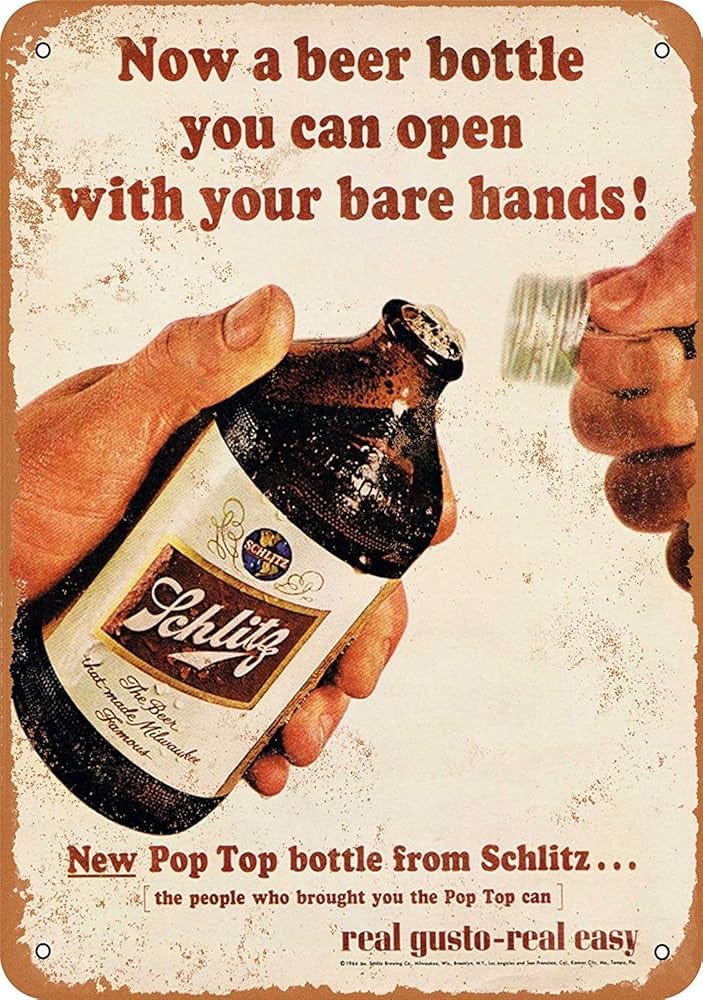
By 1902, Schlitz dominated American beer culture, becoming the largest brewery in the world! Schlitz survived Prohibition by producing chocolates. Schlitz innovated. They pioneered the use of brown glass bottles on a massive scale then popularized the pop top.
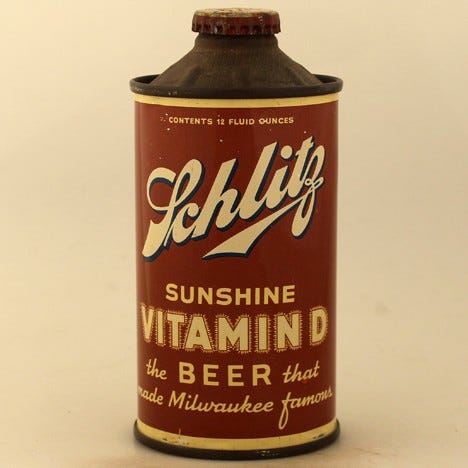
How innovative? Try Schlitz Sunshine Vitamin D Beer. Inspired by the Progressive impulses at the University of Wisconsin, the campaign positioned the brew as the ultimate cure for the physical tolls of modern, indoor living.
Innovation aside, the history teacher in me must note that neither Milwaukee nor Chicago newspapers from 1871 or 1872 reported on Schlitz’ noble gesture to support Chicagoans. And given the brewery’s relatively modest production at the time, the image of Schlitz riding into the smoldering ruins of Chicago atop a mountain of giveaway lager owes more to the marketing department than to the historical record.
As we see, in addition to innovating, Schlitz was fearless, sometimes tasteless, in their marketing.
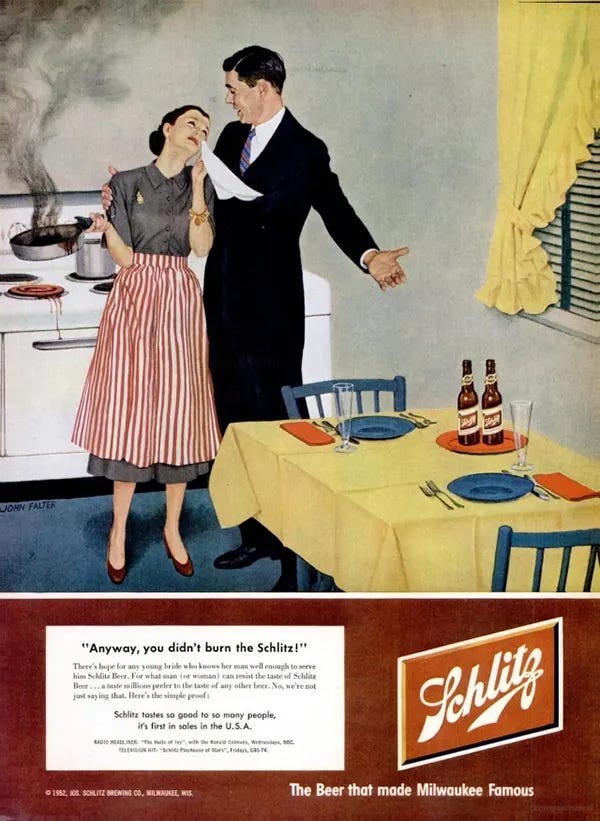


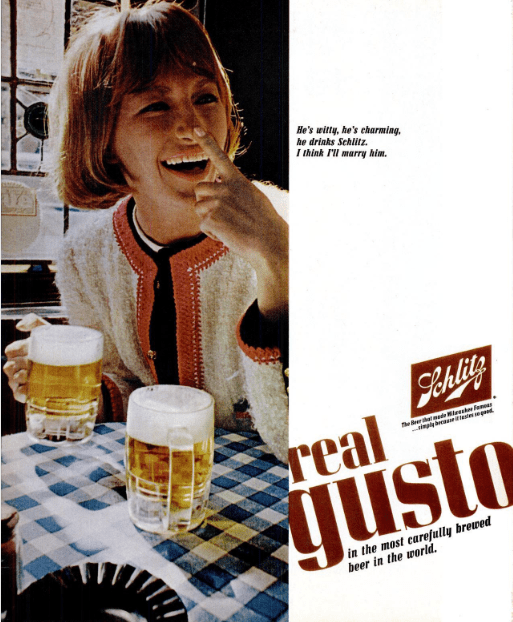
Don’t shoot the messenger. I’m a feminist, just reporting what is. And don’t blame Joseph Schlitz for the misogyny.
Poor Schlitz hardly got to enjoy the fruits of the empire he helped build. Just a few years after the Chicago Fire (the disaster, not the team), after more than a quarter century away from his homeland, he set out to visit his birthplace of Mainz, Germany. His journey ended in tragedy when the SS Schiller wrecked off the coast of Cornwall. More than 300 passengers perished. For a ship named after Friedrich Schiller, the SS Schiller delivered a dreadfully literal interpretation of German tragedy.*
Thank you.
Schlitz’ death sent shockwaves through Milwaukee. Business leaders and civic groups publicly mourned his passing. A memorial was erected in his honor despite one haunting detail: his body was never recovered. His widow even offered a substantial reward in hopes of locating his remains, but the sea sealed his fate.
However, the sea did not have the last word. Schlitz’ sizable life insurance payout helped fuel the continued expansion of the brewery that bore his name.
Schlitz Beer survived the tragic deaths of two owners, the Civil War, Prohibition, two World Wars, and countless churlish marketing campaigns. But, like so many American businesses, it couldn’t survive the 20s.
On May 23, 2026, “The Beer that Made Milwaukee Famous” brewed its final batch.
Alas, I promised you something lighter and somehow still found my way back to the heaviness. Old habits die harder than old breweries.
Prost!
DL
*German maritime historians still wonder what the SS Schiller was sinking about. Ba-dum-tss!
Hey you! I’m trying to sustain the quality and frequency of The Junction. It’s a labor of love, but it is labor. It helps me when you subscribe, free or paid. At the very least, enjoy a free subscription.
If you don’t want to become a paid subscriber, but support me and want to show it, PayPal me a one-time donation. If you don’t like PayPal, you can buy me a coffee.
If money is tight, you can still help. How? Share The Junction with someone who might appreciate it.
Oh, and you’re always invited to check out my other projects over here.
Great title, even better article. Especially the bit about U.S. soccer teams being named after catastrophes, I never thought about that. Even though I am fairly certain I never drank Schiltz, it is a sad day for the original Milwaukee breweries.
https://mailchi.mp/abb7238f30a8/schiddys-tiki-and-more-11046817?e=5224290845
The owner of some of the fanciest restaurants in Vermont (no flannel) is a huge fan of Schlitz. His grandfather worked there for 36 years.
This Thursday he is hosting a funeral/memorial for the fallen brew. Time to dust off my black suit for this somber occasion.