
Beyond Left and Right
Politics after certainty

Last week, Abdul Ballout, 21, drove a rented van into a crowd near the Christopher Street Day celebration in Berlin before continuing his assault with a knife, killing one and seriously injuring 31 others.
That same day, I got a message from a former student. She was an extraordinary student and I imagine she’s become an extraordinary adult. She has a life and a wife and a kid and a job—the full catastrophe.
After offering words of gratitude and reflecting graciously on our classes together—recalling moments in our class that had faded into what’s left of my memory—she asked me how I would describe my political ideology.
In fact, and to be more precise, she wrote, “I don’t think I ever quite pinned down your ideology or general political position when I was in your comparative politics class and I’m even less certain now when I read you on Substack. So if you don’t mind me asking, how would you describe your political ideology? And how has your ideological worldview changed in the years since I was in your class?”
I didn’t quite know how to respond. I still don’t. But here’s what I’ve got so far…
How would I describe my political ideology? Generally speaking, I wouldn’t. Not in the classroom. Not in email exchanges. Not on Substack.
If pressed to describe my political ideology, I would only do so in person, preferably over drinks, with someone who loves me unconditionally, who wouldn’t rush to judge me, who understands my willingness to learn and grow, who has empathy for my (sometimes desperate) need for acceptance, and who sees my ideology as just a part of who I am.
But even over beers with my most empathic, non-judgemental, OG pals, I might resist. I’m not tempted to issue my manifesto. I’m not ready to pen myself in with the sharp edges of words. This is the business of someone much younger, or older, or wiser than me.
Confession: I was once an ideologue. But teaching taught me that ideological thinking didn’t lead me to a better understanding of the world or my role in it. Rather, ideological thinking gave me a permission structure to double down on my (often cockamamie!) prejudices and beliefs.
Ideological thinking boxed me in to seeing the world with a defined set of expectations, narrowing my view. It made me less able to see without looking for something. It made it hard to see with my own eyes.
So thanks for inquiring, but I’m not sure how much political ideology actually matters in our times. I’m also not sure how much it should matter.
Throughout modern history, political ideologies have provided people with a framework to interpret the world. For better and worse, ideological thinking is a hallmark of modernity.
From political movements to religious doctrines, from economic theories to cultural revolutions, ideological thinking has structured our beliefs and guided collective action. Ideology has provided a comprehensive worldview. A sense of belonging. A clear roadmap for progress. Certainty. But as history unfolded, so did the complexities that our ideological frameworks fail to grapple with.
The fall of the Soviet Union was hailed as the “end of history” by Francis Fukuyama. Liberal democracy had won the ideological war once and for all. Huzzah!
Yet history continued, revealing the chasm between ideological victory and practical governance. The rise of populism, globalization, identity politics, and climate crises demonstrates that no single ideology had all the answers.
Intellectual debates over the utility of ideological thinking have been simmering for a long time. In The Origins of Totalitarianism (1951), Hannah Arendt argues that, “the ideal subject of totalitarian rule is not the convinced Nazi or the convinced Communist, but people for whom the distinction between fact and fiction, true and false, no longer exists.” I might add to her list “right and wrong.” She goes on to say that, “totalitarianism has demonstrated that ideology can lead to the death of thought itself. What follows is not necessarily freedom but a vacuum waiting to be filled.”
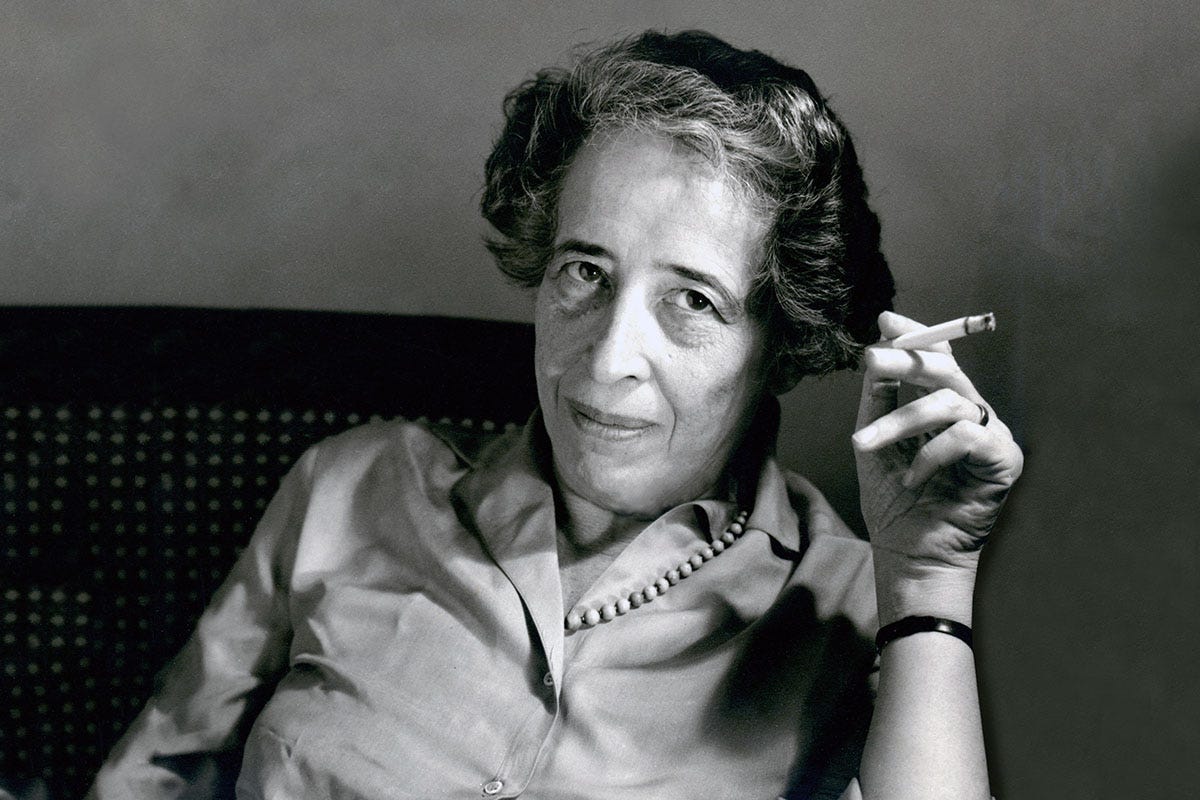
Arendt had an immeasurable impact on two generations of philosophers and public intellectuals that followed her, some of whom argue that the age of ideology ended. Tony Judt, for instance, claims that, “we have entered an age of post-ideological politics, where the struggle is no longer between capitalism and socialism but between competing versions of the same managerial state.” Bruno Maçães is blunt about his view that, “the world is no longer ideological; it is transactional. Power is its only currency.” And Yuval Noah Harari offers a different angle: “Liberalism, socialism, and fascism were once great religions; today, the real power belongs to technology and market forces.” Many argue that rigid ideological thinking no longer serves us in our rapidly changing world.
On the other hand, Arendt also had a profound impact on philosophers who seek to perpetuate ideological rigor. Notable among these, Slavoj Žižek argues that, “The end of ideology is itself an ideology—the most dangerous one, because it makes us blind to the ideological forces shaping our world.” Building on this, Chantal Mouffe argues that democracy needs competing ideologies; pretending politics can be ideology-free suppresses conflict rather than resolving it.
Mouffe isn’t wrong. Absent grand narratives, new forms of tribalism have emerged. Instead of unifying ideological movements, we now have fragmented, issue-specific agendas: climate activism, tech agendas, identity politics, etc.
Moreover, without ideological structures, our discourse can become reactive, focusing more on opposition than on long-term vision. This leads to the problem of resentment that I’ve been writing about lately (here and here).
In trying to arrange my thinking about ideology, both to respond to my former student and to clarify my own thoughts (which is why I’m on Substack to begin with), I present to you, drum roll please………………………………
5 Questions Guiding My Thinking About Ideology:
While it’s hard to take the temperature of the water in the throes of a tsunami, what exactly is the state of play of political ideology, particularly in the West?
Is a world without ideology likely to descend into a world without ideals?
Without political ideology, do we risk drifting into a world where power, rather than principle, dictates policy?
If ideological thinking is fading, what comes next?
Is governance based on pragmatism, collaboration, and adaptability rather than dogma a legit possibility?
Disclosure: I am tremendously skeptical of the utility of ideological thinking in our times. Skeptical, not dismissive. With all due respect to Mamdani and The Squad—and with no respect for Stephen Miller or The Freedom Caucus—I’m not persuaded that our 19th-century ideologies are particularly suited to our 21st-century problems. To play on a quip by a repugnant idealogue, I think that trying to cure modern maladies with ideology is like trying to cure leukemia with leeches.
Abdul Ballout was German of Lebanese descent, a murderer, and a terrorist. He was also an ideologue, a jihadist. He desperately tried to join ISIS, an ultra-traditionalist, theocratic, anti-liberal, anti-egalitarian, anti-LGBTQ, anti-Semitic, anti-secular, anti-feminist, right-wing ideology.
Here's the strange thing. Many wise and wordly folks have such a rigid mental model of the political right that they simply cannot process the idea that a dude named Abdul might belong to it. Even very clever people seem unable or unwilling to countenance that dissonance. To them, all the Abduls are victims of the right.
So as a result of his murderous right-wing rampage to Make the Caliphate Great Again, the jihadist gets his martyrdom, the AfD gets a bump in the polls, and ideology claims another victory over wisdom.
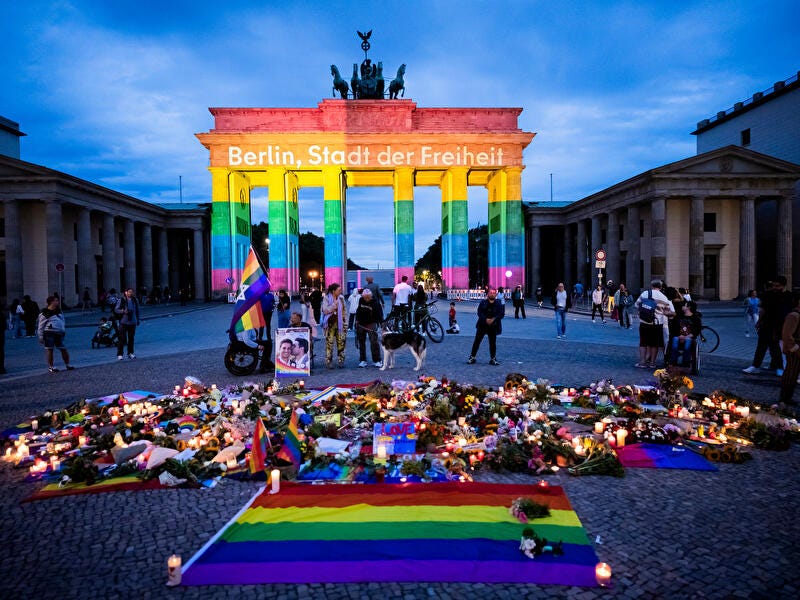
In sympathy for the victims and with mad love for our LQBTQ+ community…
-DL
Hey you! I’m trying to sustain the quality and frequency of The Junction. It’s a labor of love, but it is labor. It helps me when you subscribe. At the very least, enjoy a free subscription.
If you don’t want to become a paid subscriber, but support me and want to show it, PayPal me a one-time donation. If you don’t like PayPal, you can buy me a coffee.
If money is tight, you can still help. How? Share The Junction with someone who might appreciate it.
Oh, and you’re always invited to check out my other projects over here.